Categories
Latest News Latest News Latest News Latest News

31/1/2024 (Wed) Parents’ Day

22/1/2024 (Mon) – 30/1/2024 (Tue) Activities Weeks

26/1/2024 (Fri) Parent-child Picnic

19/1/2024 (Fri) Parent-child Picnic

Categories
Latest News

12/1/2024 (Fri) Birthday Party

Categories
Parenting Articles

Is parent-child reading becoming stressful?

Parent-child reading senior worker: Choi EE


Do you have kids who insist on you telling them stories? And not just any stories, they want you to keep going. When you come home from work, they have a stack of books and won’t eat until you finish all of them or want you to keep going for two hours. This is a common issue that I frequently encounter in my lectures. Parents, think about it: when you engage in parent-child reading with your kids, what do you hope for the most?


You certainly hope to create a warm memory because when they listen to your stories, they are especially well-behaved and feel secure. However, if the children turn listening to stories into your stress, demanding many stories, even refusing to listen to others, and only wanting to hear you as if they’re monopolizing your personal time, you should consider how to resolve this issue for yourself.

I suggest that in the context of parent-child reading, spend a good 15 to 20 minutes sharing a story with your child, and even half an hour is fine. However, if you find yourself spending two hours each day telling them an entire book, and they still feel unsatisfied and demand that you keep going as if they’re controlling you, it’s no longer a parent-child reading relationship but more of a tutoring relationship. We should set an example and tell the child, “I need to have some personal time. Today, storytime is 15 minutes, and Mom will tell you two books. After we’re done, we can do other things, or we can discuss the story we just read while you’re playing or eating.”


You shouldn’t turn into a radio, constantly narrating stories like a recording machine, as that’s not what we want in parent-child reading. So, parents, remember that when your child asks you to tell a story, it’s a joyful moment. We shouldn’t be afraid of telling stories to our children. Instead, we should control our time, casually finish a story in about half an hour, and then have a meal together or engage in play, followed by discussing the story. I believe that in a quality parent-child reading relationship, children will develop a greater love for reading and see it as a path to new horizons.

Categories
Parenting Articles

Be a parent with multiple expressions and poses!

Written: Founder & Volunteer Director of Good Love Passion, Lam Ho Pui Yee


When a child is around 6 months old, they start babbling, constantly making sounds and single words. They also enjoy playing with toys that make sounds. However, even before they learn to speak, they already understand how to communicate with the people around them using crying, sounds, facial expressions, gestures, or body language. In fact, children first learn to communicate with people using facial expressions and gestures, then they learn verbal communication, and finally, they learn to communicate through text. Therefore, accurately recognizing other people’s facial expressions helps in assessing their emotions and attitudes, thus influencing a child’s cognitive development, emotional development, and social skills. Parents’ facial expressions, actions, and postures are often what children find most attractive.


Children observe and respond to their parents’ facial expressions and emotions. For example, a gentle expression can make them feel comfortable communicating with you, a smile can boost a child’s confidence in expressing themselves, and a nod from parents indicates acceptance. Through these developments, children gradually understand, learn, and care about people’s emotions. Different parts of the body express emotions in various ways, and expressions can be categorized into facial expressions, body expressions, and verbal expressions.


To establish good parent-child communication, parents need to pay attention to several aspects:


1.When children cannot clearly see their parents’ facial expressions, it is recommended to use actions as a substitute for speech responses. For example, hugging them tightly, giving them a kiss, gently stroking their hair, or gently touching their cheeks are all important non-verbal communication methods.

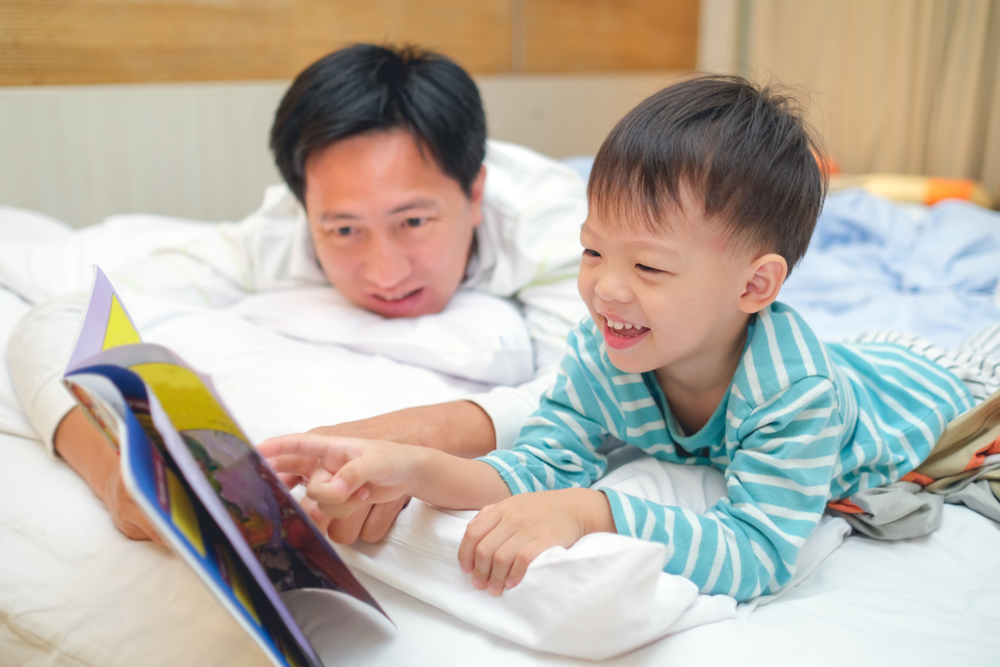
  1. If parents can embody a childlike and expressive role in their daily lives, children can learn a wealth of emotions and expressive skills from their parents’ facial expressions. This will undoubtedly benefit them throughout their lives.


  1. Many parent-child interaction patterns involve “non-interaction” – even though they are together, there is no eye contact, conversation, message exchange, or actions, and there is no emotional sharing because everyone is watching TV, using the computer and phones, or doing their own things. Eye contact can train focus, so regularly gazing at each other with caring eyes and listening to each other’s sharing is one of the conditions for good communication.
  1. Creating a quiet and simple environment helps children concentrate. True and comprehensive communication happens when they can clearly see your facial expressions. Therefore, it’s appropriate to turn off sound-producing items like the TV, tablet, or take away their beloved toys during communication.


On the journey of a child’s growth, parents who are willing to provide unconditional love and ample communication space make children feel accepted, allowing them to break free from their cocoon. Children love it when their parents appreciate them, so encouragement often has a greater impact, whether through eye contact or speech; both can be used more frequently.